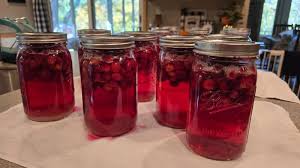
Prep Time | 15 minutes |
| Cook Time | 20 minutes (including juicing and heating) |
| Process Time | 15 minutes (pints) / 20 minutes (quarts) |
| Passive Time | 2 hours (straining) + 12–24 hours (cooling) |
| Total Time | Approximately 3 hours (active + passive) |
| Intensity Level | Moderate – Requires attention to headspace, temperature (190°F), and water bath timing, but no special pressure canning equipment. |
Yield: Approximately 4 pints (or 2 quarts)
Ingredients
-
8 cups fresh cranberries (about 2 ½ pounds), washed and sorted (discard soft or wrinkled berries)
-
8 cups water
-
Sugar (optional) – Start with 1 to 2 tablespoons per cup of finished juice, or ¼ to ½ cup per jar if you prefer a sweeter concentrate
-
Optional flavoring: A strip of orange peel or a cinnamon stick added during the final heating (do not add to jars unless using a tested recipe)
Equipment: Water bath canner, large pot, jelly bag or fine-mesh strainer lined with damp cheesecloth, 4 pint jars or 2 quart jars, canning lids and rings, jar lifter, bubble remover, candy thermometer.
Instructions
Step 1: Cook the Cranberries (5 minutes, Medium-High Intensity)
Combine the cranberries and water in a large pot. Bring to a boil over medium-high heat, then reduce to a gentle boil. Cook until the skins pop and the berries soften—about 5 minutes. Do not overcook; you want the juice, not mush.
Step 2: Strain the Juice (2 hours, Passive)
Carefully pour the hot cranberry mixture into a jelly bag or a fine-mesh strainer lined with damp cheesecloth set over a large bowl. Do not press or squeeze. Let gravity do the work for at least 2 hours. Pressing will cloud the juice and make it gritty. For extra-clear juice, refrigerate the strained liquid overnight and decant off any sediment.
Step 3: Prepare Jars and Canner (10 minutes, Low Intensity)
While the juice drains, wash jars in hot soapy water and keep them hot in the water bath canner filled with simmering water. Wash lids and rings. Have your jar lifter and clean towels ready.
Step 4: Sweeten and Heat the Juice (5 minutes, Medium Intensity)
Pour the strained juice into a clean stainless steel pot. Add sugar to taste if desired—start conservatively; you can always add more when serving. Heat the juice to 190°F and hold it there for 5 minutes. Use a candy thermometer to monitor; do not let it boil hard, as this can affect flavor and safety margins.
Step 5: Fill the Jars (5 minutes, Moderate Intensity)
Remove hot jars from the canner. Ladle the hot juice into jars, leaving ¼ inch headspace for pints or ½ inch for quarts. Run a bubble remover around the inside of the jar to release trapped air. Wipe rims with a damp cloth (a vinegar-dampened cloth helps remove any residue). Apply lids and rings fingertip-tight.
Step 6: Water Bath Process (15–20 minutes, Moderate Intensity)
Lower jars into the canner, ensuring they are covered by at least 1–2 inches of water. Bring to a rolling boil. Process pints for 15 minutes and quarts for 20 minutes (adjust for altitude: add 5 minutes for 1,001–3,000 ft; add 10 minutes for 3,001–6,000 ft).
Step 7: Cool and Check Seals (12–24 hours, Passive)
Turn off heat, remove canner lid, and let jars sit 5 minutes before lifting them out. Place on a towel-lined counter undisturbed for 12–24 hours. Check seals by pressing the center of each lid—it should be concave and not pop back. Unsealed jars should go in the fridge and be used within 5 days.
Nutrition (per 1-cup serving, unsweetened)
Values are approximate and based on unsweetened homemade juice; adding sugar will increase carbohydrates and calories.
| Nutrient | Amount |
|---|---|
| Calories | 116 kcal |
| Total Fat | 0.3 g |
| Carbohydrates | 31 g |
| Dietary Fiber | 0.3 g |
| Total Sugars | 31 g (natural fruit sugar) |
| Protein | 1 g |
| Vitamin C | ~24 mg (26% DV) |
| Vitamin K | ~13 mcg (11% DV) |
| Sodium | ~5 mg |
| Potassium | ~195 mg |