Prep Time: 25 minutes
Fermentation Time: 5–7 days
Total Time: 5–7 days, 25 minutes
Difficulty: Easy
Intensity Level: Low–Moderate (light hands-on work, mostly passive waiting)
Introduction
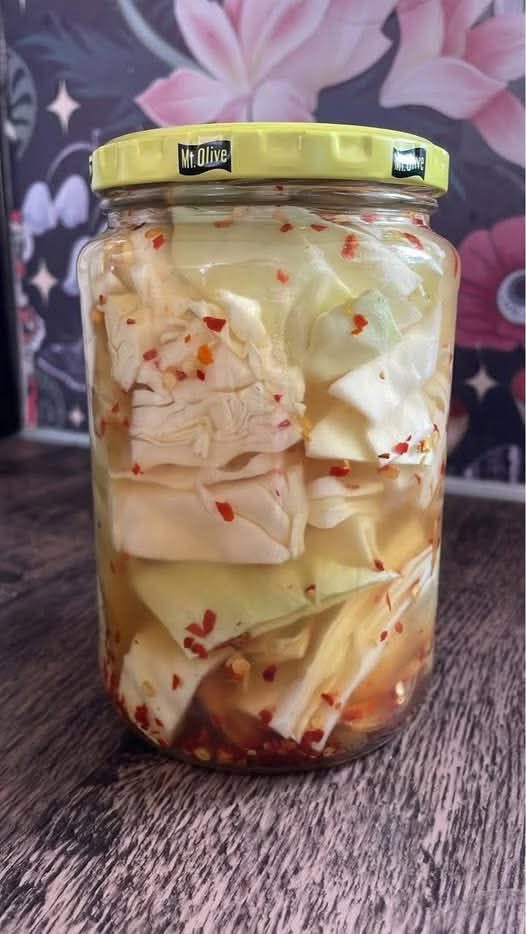
Pickled Cabbage with Fermented Honey Garlic is a bright, crunchy, probiotic-rich condiment that balances tangy cabbage with the mellow sweetness and umami depth of fermented honey garlic. The cabbage is quick-brined in a vinegar-salt solution infused with garlic, honey, and warming spices, while a spoonful of fermented honey garlic (and a splash of its syrup) adds a gentle, floral sweetness and a subtle fermented funk that takes this pickle from ordinary to unforgettable.
Serve it alongside grilled meats, roasted vegetables, sandwiches, grain bowls, or charcuterie. It also makes an excellent topping for tacos, burgers, and rice dishes. Once you make it, you’ll want a jar in the fridge at all times.
Why You’ll Love This Recipe
-
Crunchy, tangy, and slightly sweet — a balanced flavor profile that complements almost anything.
-
Probiotic-friendly — the fermented honey garlic introduces beneficial bacteria (note: the vinegar brine is not a true ferment, but the fermented garlic contributes live cultures).
-
Small-batch friendly — makes two jars, perfect for gifting.
-
Flexible — adjust honey, spice, or garlic to taste.
-
No special equipment — just jars, a knife, and a pot.
Ingredients
For the Cabbage
-
1 medium head green cabbage (about 2–2.5 lbs / 900 g–1.1 kg), cored and finely shredded
-
1 tbsp coarse sea salt or pickling salt (plus more to taste)
-
1 large carrot, julienned (optional, for color and crunch)
-
1 small red onion, thinly sliced (optional)
For the Brine
-
2 cups (480 ml) filtered water
-
1 cup (240 ml) white vinegar (5% acidity) or apple cider vinegar
-
1/2 cup (120 ml) raw honey (or fermented honey syrup from the garlic jar)
-
1 tbsp fermented honey garlic cloves, minced (plus 1–2 tbsp of the fermented honey syrup from the jar)
-
1 tsp black peppercorns
-
1 tsp mustard seeds
-
1 tsp coriander seeds
-
2 bay leaves
-
1/2 tsp red pepper flakes (optional, for heat)
-
1 tsp dill seeds (optional)
Optional Add-Ins
-
2–3 whole garlic cloves (extra)
-
1 tsp grated fresh ginger
-
1 small hot chili, sliced
Equipment
-
2 clean quart-sized (1 L) glass jars with lids (sterilized)
-
Large mixing bowl
-
Medium saucepan
-
Wooden spoon or tongs
-
Knife and cutting board
-
Measuring cups and spoons
-
Clean kitchen towel or fermentation weight (optional)
Instructions
Step 1: Prepare the Cabbage (10 minutes | Intensity: Low)
-
Remove the outer leaves of the cabbage and cut it into quarters. Trim out the core.
-
Finely shred the cabbage using a sharp knife or mandoline. You should have about 8–10 cups of shredded cabbage.
-
Place the shredded cabbage in a large bowl and sprinkle with 1 tbsp coarse salt. Massage the salt into the cabbage with clean hands for 3–5 minutes, until the cabbage begins to soften and release moisture.
-
Let the cabbage rest for 10 minutes while you prepare the brine. (This step helps draw out water and makes the cabbage more pliable.)
Step 2: Make the Brine (5–7 minutes | Intensity: Low)
-
In a medium saucepan, combine the filtered water, vinegar, honey, fermented honey garlic cloves, fermented honey syrup, peppercorns, mustard seeds, coriander seeds, bay leaves, red pepper flakes, and dill seeds (if using).
-
Bring the mixture to a gentle simmer over medium heat, stirring until the honey dissolves completely. Do not boil vigorously — you want to preserve the delicate flavors of the honey and garlic.
-
Once the honey is dissolved, remove from heat and let the brine cool for 5 minutes. It should be warm, not boiling, before pouring over the cabbage.
Step 3: Pack the Jars (5 minutes | Intensity: Low)
-
If using carrot and red onion, toss them with the salted cabbage.
-
Tightly pack the cabbage mixture into the sterilized jars, pressing down firmly with a wooden spoon or clean hands to eliminate air pockets. Leave about 1 inch (2.5 cm) of headspace at the top.
-
Tuck in any optional add-ins (extra garlic cloves, ginger, chili) between the cabbage layers.
Step 4: Add the Brine (2 minutes | Intensity: Low)
-
Pour the warm brine over the cabbage, ensuring all the cabbage is submerged. The brine should cover the cabbage by at least 1/2 inch (1.25 cm).
-
If needed, add a little extra vinegar and water (1:1 ratio) to top off the jars.
-
Wipe the rims of the jars with a clean, damp cloth to remove any brine or debris. Seal tightly with lids.
Step 5: Ferment (5–7 days | Intensity: Passive)
-
Place the jars in a cool, dark place (ideally 65–72°F / 18–22°C) for 5–7 days.
-
Burp the jars once daily: unscrew the lid briefly to release any built-up gas, then reseal. This prevents pressure buildup and ensures safe fermentation.
-
Taste the cabbage after 3 days. If you prefer a milder pickle, transfer to the refrigerator. For a tangier, more fermented flavor, let it go the full 7 days.
-
If you see white film or scum on the surface, skim it off. (This is harmless kahm yeast.) If you see fuzzy mold, discard the batch.
Step 6: Refrigerate and Store (5 minutes | Intensity: Low)
-
Once the pickles reach your desired tanginess, transfer the jars to the refrigerator.
-
The pickles will keep for up to 2 months in the fridge. The flavor will continue to develop and deepen over time.
Time and Intensity Summary
| Phase | Time | Intensity |
|---|---|---|
| Prep cabbage | 10 min | Low |
| Make brine | 5–7 min | Low |
| Pack jars | 5 min | Low |
| Add brine | 2 min | Low |
| Ferment | 5–7 days | Passive |
| Refrigerate | 5 min | Low |
| Total | 5–7 days + ~30 min active | Low–Moderate |
Tips for Success
-
Use fresh, firm cabbage. Older cabbage will yield softer pickles.
-
Don’t skip the salt massage. It draws out moisture and helps the cabbage absorb the brine.
-
Keep everything submerged. Exposure to air can cause spoilage. Use a fermentation weight or a small zip-top bag filled with brine if needed.
-
Taste as you go. Fermentation is personal — adjust the time to your preference.
-
Use raw honey if possible. It contains natural enzymes and adds a richer flavor.
-
Fermented honey garlic is key. If you don’t have any, you can substitute 1 tbsp minced fresh garlic and 1 tbsp honey, but the flavor will be less complex.
Variations
-
Spicy Pickled Cabbage: Add 1–2 sliced jalapeños or 1 tsp gochugaru (Korean red pepper flakes).
-
Dill-Forward: Add 2 tbsp fresh dill or 1 tbsp dill seeds.
-
Apple-Infused: Add 1/2 sliced apple to the jar for a fruity note.
-
Turmeric-Ginger: Add 1 tsp ground turmeric and 1 tbsp grated ginger for a golden, anti-inflammatory twist.
-
Low-Sugar: Reduce honey to 1/4 cup and increase fermented honey syrup to 2 tbsp.
Serving Suggestions
-
On tacos, burgers, and sandwiches
-
Alongside grilled sausage, pork, or chicken
-
Stirred into grain bowls or salads
-
On a charcuterie board with cheese and crackers
-
As a side to roasted potatoes or pierogi
-
Chopped and mixed into tuna or egg salad
Nutrition Information (per serving)
Serving Size: About 1/2 cup (approx. 100 g)
Servings Per Recipe: 8
| Nutrient | Amount |
|---|---|
| Calories | 45 kcal |
| Total Fat | 0 g |
| Saturated Fat | 0 g |
| Trans Fat | 0 g |
| Cholesterol | 0 mg |
| Sodium | 320 mg |
| Total Carbohydrates | 11 g |
| Dietary Fiber | 2 g |
| Total Sugars | 8 g |
| Added Sugars | 7 g |
| Protein | 1 g |
| Vitamin C | 30% DV |
| Vitamin K | 20% DV |
| Calcium | 2% DV |
| Iron | 3% DV |
| Potassium | 150 mg |