-
Prep Time: 15 minutes
-
Cook Time: 10 to 12 minutes
-
Chilling Time: 2 to 4 hours (or overnight)
-
Total Time: ~3 hours 30 minutes
-
Course: Condiment, Spread, Dessert Filling
-
Cuisine: Classic British / American Bakery Staple
-
Yield: Approximately 1.5 cups (about 12 servings)
-
Intensity Level: Easy / Beginner-Friendly (Requires constant attention and gentle heat control)
Why You Will Love This Recipe
-
Incredible Depth of Flavor: Using both freshly squeezed lemon juice and the aromatic lemon zest infuses the curd with maximum citrus oils, creating a deeply fragrant profile.
-
Silky Smooth Texture: Praining the curd through a fine-mesh sieve at the very end guarantees a glass-smooth finish free of any stray bits of cooked egg or zest.
-
Versatility: It serves as a brilliant filling for cakes, tarts, macarons, and thumbprint cookies, or as a decadent topping for yogurt bowls, pancakes, and waffles.
-
No Artificial Additives: Completely free of preservatives, yellow food dyes, or cornstarch shortcuts—just pure, wholesome ingredients.
Ingredients
To achieve the best possible flavor and gloss, use fresh lemons and high-quality, unsalted butter.
-
Fresh Lemons: 4 to 5 medium-large lemons (You will need $\frac{1}{2}$ cup of freshly squeezed lemon juice and 1 tablespoon of finely grated lemon zest).
-
Granulated Sugar: 1 cup (Standard white sugar provides clean sweetness that allows the lemon flavor to shine).
-
Large Eggs: 3 whole large eggs (ensure they are at room temperature for even blending).
-
Large Egg Yolks: 2 large egg yolks (these add extra richness, structure, and a deeper golden hue).
-
Unsalted Butter: $\frac{1}{2}$ cup (1 stick), cut into 8 small cubes and chilled slightly.
-
Salt: $\frac{1}{4}$ teaspoon (Fine sea salt or kosher salt to balance the sharp acidity and enhance the overall flavor).
Step-by-Step Instructions
Step 1: Prep Your Equipment and Station
Before you begin cooking, gather your tools. You will need a non-reactive saucepan (such as stainless steel or enameled cast iron; avoid plain aluminum or copper, which can react with the acid in the lemons and impart a metallic taste), a whisk, a heat-proof rubber spatula, and a fine-mesh sieve placed over a clean glass bowl.
Step 2: Extract Zest and Juice
Thoroughly wash and dry your lemons. Using a fine microplane grater, zest only the bright yellow outer layer of the lemons, avoiding the bitter white pith underneath. Measure out 1 tablespoon of zest. Next, cut the lemons in half and juice them until you have exactly $\frac{1}{2}$ cup of fresh juice. Strain out any large seeds or pulp if desired.
Step 3: Muddle Sugar and Zest
In your non-reactive saucepan, combine the granulated sugar and the grated lemon zest. Using your clean fingertips, rub the zest directly into the sugar for about 30 seconds. This releases the essential citrus oils from the zest into the sugar grains, dramatically intensifying the aromatic lemon flavor of your finished curd.
Step 4: Whisk Eggs, Yolks, and Salt
Add the whole eggs, egg yolks, and salt to the sugar-zest mixture. Whisk vigorously for about 1 to 2 minutes until the mixture becomes pale, slightly thickened, and completely smooth.
Step 5: Incorporate Lemon Juice
Pour the $\frac{1}{2}$ cup of fresh lemon juice into the egg mixture while continuing to whisk constantly until fully combined.
Step 6: Cook Over Gentle Heat (The Double Boiler Method or Direct Low Heat)
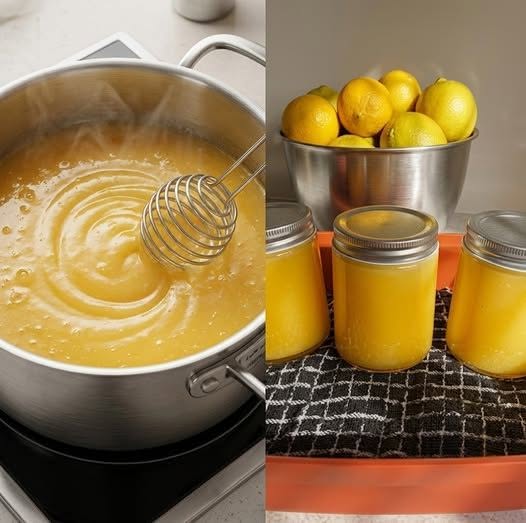
Place your saucepan over low to medium-low heat. Cook the mixture, stirring and whisking constantly with your rubber spatula or whisk—making sure to sweep across the bottom and edges of the pan to prevent any eggs from scrambling.
-
Intensity & Temperature Control Note: Patience is your best friend here. Never crank the heat up to high. Gentle, consistent heat is required to thicken the eggs and butter without turning your curd into scrambled eggs.
Continue cooking for about 10 to 12 minutes. As the mixture heats up, the foam on top will subside, and the liquid will gradually thicken until it coats the back of a spoon. When you draw your finger across the back of the spoon, the line should hold cleanly without running. It should reach a consistency similar to a thick gravy or warm pudding (around 160°F to 170°F if using a digital thermometer).
Step 7: Strain and Add Butter
Remove the saucepan from the heat immediately. Pour the hot lemon curd through your prepared fine-mesh sieve into the clean bowl, using your spatula to press it through. This catches any bits of cooked egg white or lingering zest.
Drop the chilled cubes of butter into the warm strained curd one by one, whisking continuously until each piece is completely melted and incorporated. The residual heat from the curd will melt the butter, resulting in a glossy, silky emulsion.
Step 8: Cool and Store
Transfer the finished lemon curd into clean glass jars or an airtight container. Press a piece of plastic wrap directly onto the surface of the warm curd to prevent a tough skin from forming as it cools.
Let the jar cool at room temperature for about 30 minutes, then transfer it to the refrigerator to chill and set fully for at least 3 to 4 hours before serving.
Professional Baker’s Tips for Success
-
Room Temperature Eggs: Using room-temperature eggs helps them incorporate smoothly into the sugar and prevents shocking the mixture when placed over heat.
-
Non-Reactive Pan is Essential: The high acidity in lemon juice reacts negatively with reactive metals like aluminum, resulting in a metallic, unpleasant taste. Stick to stainless steel or ceramic-coated pots.
-
Don’t Stop Whisking: Leaving the curd unattended even for 30 seconds over the heat can cause the eggs at the bottom to curdle. Stay close to the stove!
Nutritional Information
Note: Nutritional values are estimated per serving (approx. 2 tablespoons), based on 12 total servings.
-
Calories: 115 kcal
-
Total Fat: 6 g
-
Saturated Fat: 3.5 g
-
-
Cholesterol: 75 mg
-
Sodium: 65 mg
-
Total Carbohydrates: 15 g
-
Dietary Fiber: 0 g
-
Sugars: 14 g
-
-
Protein: 2 g